
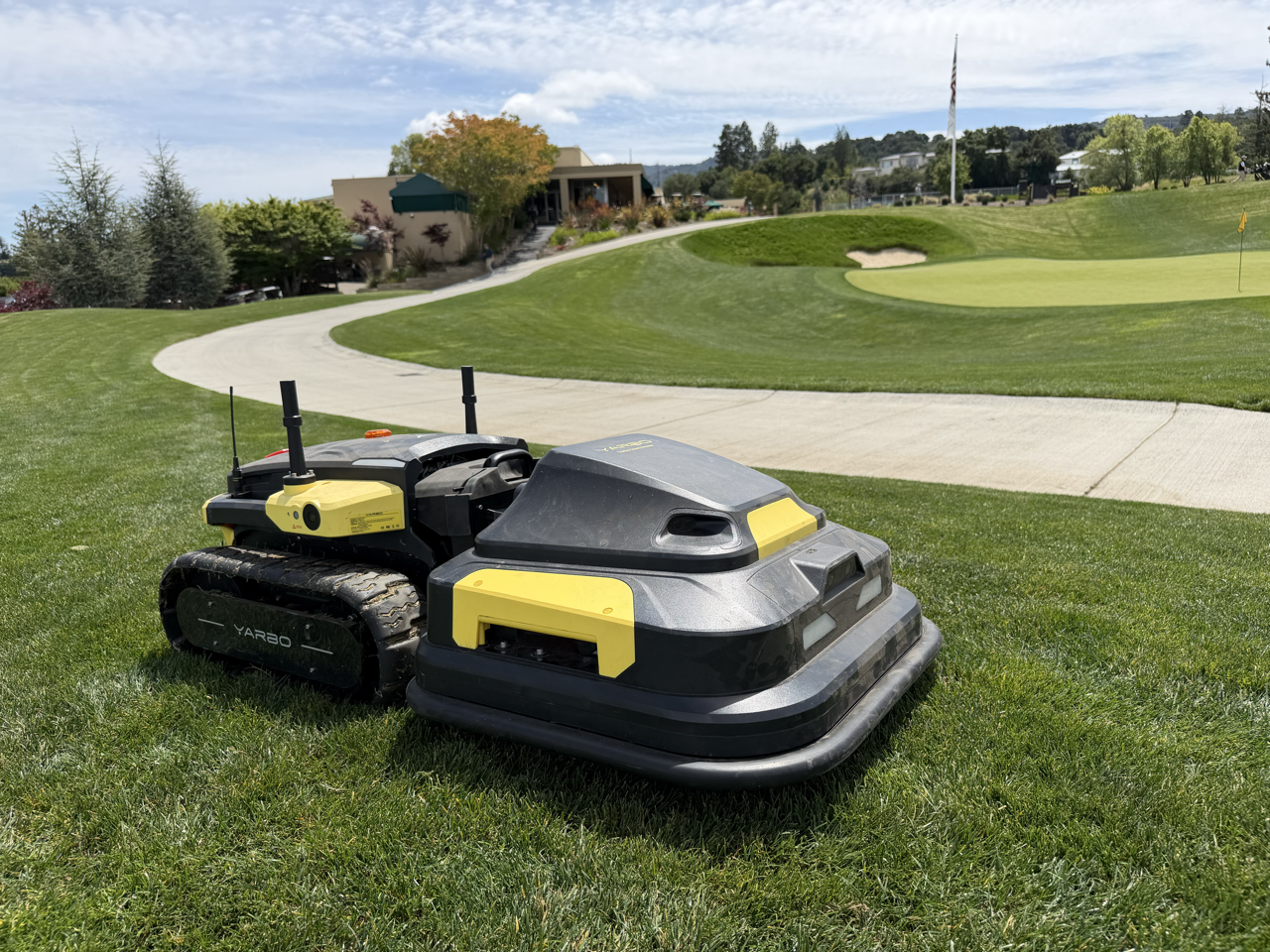
Autonomous mowing in golf courses works best when it is treated as a labor optimization tool, not a simple staff replacement strategy. In a pilot program at Palo Alto Hills Country Club, the clearest value was offloading repetitive mowing so skilled crew members could spend more time on turf health, playability, and course-detail work.
For operators evaluating a robotic mower golf course program, the practical question is not whether automation can mow grass. The more useful question is where autonomous turf equipment fits into daily maintenance workflows without disrupting play, safety, or crew priorities.
Why Golf Courses Are Rethinking Autonomous Mowing
Golf course maintenance is not just coverage. Crews are responsible for turf health, visual consistency, irrigation response, edge detail, bunker conditions, and playability across changing weather and traffic patterns.
Routine mowing can consume a large share of available labor time. Autonomous mowing changes that allocation by allowing repetitive coverage zones to run with less manual intervention while staff focus on work that requires judgment.
That makes golf course maintenance automation most useful when it supports the existing team. The goal is smarter operations, not automation for its own sake.
What Actually Improves with Autonomous Mowing
Labor Optimization, Not Replacement
Robotic mowing solutions are strongest in repeated, high-frequency coverage zones. When those zones are assigned to autonomous systems, crews can redirect time toward:
- Irrigation tuning and response
- Turf diagnostics and spot treatment
- Edging, bunkers, and finish detail
- Greens and high-visibility refinement
- Maintenance prioritization during busy course windows
The observed value is a better use of the same team. Autonomous mowing handles repetitive motion; skilled staff handle the work that affects course quality most directly.
Consistency at Scale
Manual mowing naturally varies with operator style, fatigue, route timing, and schedule pressure. Autonomous mowing can provide repeatable patterns and predictable coverage in the right zones.
That consistency matters for roughs, perimeters, practice facilities, and other broad areas where stable appearance over time is more valuable than constant manual adjustment.
Flexible Operations Around Play
Autonomous mowers can be scheduled around the course, the crew, and player traffic. Depending on the deployment zone and operating policy, robotic mowing may run off-hours, in parallel with staff, or during windows that reduce daytime congestion.
For smart golf course operations, this flexibility is often as important as the machine itself. A mower that fits the workflow creates less friction than one that requires the operation to reorganize around it.
Case Study: Palo Alto Hills Country Club Pilot
Allbotz supported a pilot program at Palo Alto Hills Country Club to evaluate how autonomous mowing performs in a real golf course environment.
The pilot objective was not to replace staff. The goals were to:
- Offload repetitive mowing tasks
- Improve labor allocation
- Observe real-world reliability
- Identify the zones where automation created operational value
Clear Value in Repetitive Zones
The pilot showed the strongest fit in large, repeatable areas with consistent terrain. These zones benefited from continuous coverage and reduced manual intervention.
This is the practical starting point for autonomous mowing golf course deployments: choose areas where the mowing task is frequent, predictable, and operationally expensive to cover manually.
Positive Labor Reallocation
Operator feedback from the pilot aligned around a simple point: the primary value was freeing workers to focus on more important turf-related responsibilities.
That feedback matters because it shifts the conversation away from abstract labor shortage messaging. In practice, labor optimization golf course programs are most credible when they help superintendents and crews protect time for higher-skill work.
Adoption Depends on Fit, Not Hype
The pilot reinforced that not every area needs automation. Deployment strategy matters more than raw robotic capability.
Successful usage depends on:
- Selecting the right zones
- Mapping those zones accurately
- Integrating routes with existing crew schedules
- Defining supervision and adjustment routines
- Reviewing whether the system is improving daily operations
Where Autonomous Mowing Works Today
Best-fit use cases for autonomous mowing in golf courses include:
- Rough mowing
- Perimeter zones
- Practice facilities
- Large repeatable areas
- Lower-risk coverage zones away from sensitive play surfaces
These environments offer clearer paths to efficiency because they combine frequent mowing needs with predictable operating boundaries.
What Operators Should Evaluate Before Deployment
Before choosing autonomous turf equipment or a commercial AI lawn mower program, golf course operators should evaluate the operating model, not only the robot.
Key questions include:
- Which mowing zones are repetitive enough to justify automation?
- How variable is the terrain, boundary condition, and obstacle profile?
- Who owns mapping, setup, supervision, and ongoing adjustment?
- When can the mower run without interfering with play?
- What operational result should define success?
- How will staff time be reallocated after repetitive mowing is reduced?
These questions help separate practical golf course robotics deployments from technology pilots that never become part of normal maintenance.
Where Many Robotics Solutions Fall Short
Building the robot is not the same as making the robot work in real operations.
Common deployment challenges include mapping, terrain variability, route setup, workflow integration, staff training, and ongoing tuning. Many robotic mowing solutions struggle when those operational pieces are treated as secondary.
For golf courses, the system needs to work with the maintenance calendar, course traffic, superintendent priorities, and safety expectations. Hardware matters, but operational alignment determines whether the deployment becomes useful.
The Role of Allbotz
Allbotz acts as a robotics solution layer for managed environments. The company is not positioned only around a single machine or manufacturer. Its role is to connect robotics technology with real operational needs and help teams deploy systems that fit the work.
For golf course robotics, that means:
- Evaluating the right automation zones
- Matching equipment to site requirements
- Supporting deployment planning and integration
- Helping operators turn automation into measurable workflow improvement
Allbotz serves as the human middleware between robotics manufacturers and end users. That layer matters because autonomous systems should not operate in isolation; they should become part of a coordinated maintenance operation.
Talk with Allbotz about autonomous mowing for golf courses
Conclusion
Autonomous mowing is not only a theoretical upgrade for golf courses; when applied to the right zones, it can also become a practical tool for improving maintenance allocation, consistency, and operational flexibility.
The Palo Alto Hills Country Club pilot showed a grounded pattern: autonomous mowing fits best where tasks are repetitive, terrain is appropriate, and staff can redirect time toward higher-value turf management.
For golf course operators, the shift is not toward robots replacing crews. The stronger opportunity is robots supporting crews as part of a smarter, more coordinated maintenance system.